
Jun 9, 2026

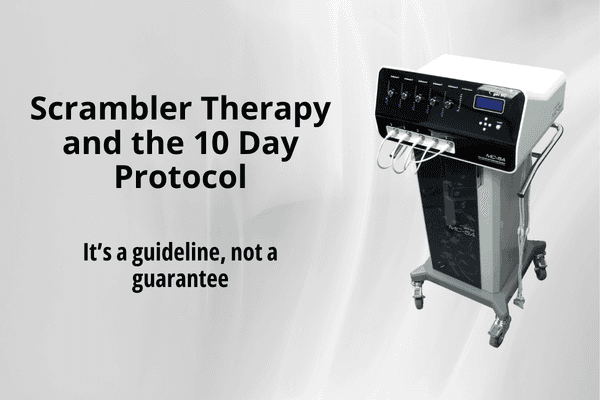
If you’ve looked into Calmare® Therapy or Scrambler Therapy® for chronic nerve pain, you’ve probably seen the phrase “10-day protocol” everywhere. It appears on clinic websites, in research papers, and throughout patient forums. But there’s an important reality that many patients eventually discover: the 10-day mark is not a finish line.
That does not mean the therapy is ineffective. Rather, treating ten sessions as a universal endpoint can create unrealistic expectations. Scrambler therapy is not one-size-fits-all. It is a guideline, not a guarantee, because every nervous system is different.
Why “10 Days” Became the Default
The original Calmare®/Scrambler Therapy research commonly used 10 consecutive daily sessions as a standardized study design. This approach allowed researchers to measure outcomes consistently across participants. Over time, the concept of a “10-day protocol” became widely adopted.
However, real-world clinical care is often more complex than a research study. Pain is influenced by many factors including age, overall health, duration of symptoms, nervous system changes, and an individual’s capacity for neuroplasticity.
The Two Biggest Variables: Age and Complexity
Clinical experience suggests that two factors often influence treatment timelines more than almost anything else: age and overall case complexity.
1. Neuroplasticity and Age
Neuroplasticity, the brain’s ability to reorganize and adapt, generally declines with age. Younger nervous systems are often more adaptable and may respond more rapidly to retraining therapies.
In younger individuals, chronic pain pathways may not yet be deeply established. When abnormal pain signaling is interrupted with scrambler therapy, the nervous system may adapt relatively quickly.
Older adults can absolutely experience meaningful improvements as well. However, when pain pathways have been reinforced for years or decades, it may require more repetitions to convince the nervous system that a persistent danger signal is no longer necessary.
2. Complexity and Comorbidities
The second major factor is how much else the body is managing simultaneously. Conditions that may influence treatment response include:
Diabetes or peripheral vascular disease, which can impair circulation and nerve health
Autoimmune conditions, which may contribute to ongoing inflammatory signaling
Post-surgical scar tissue or nerve injury
Long-term use of medications that affect pain processing
Multiple pain sites or widespread conditions such as fibromyalgia
None of these factors necessarily prevent success with scrambler therapy. They simply highlight why treatment timelines vary from person to person.
A patient with isolated post-herpetic neuralgia affecting one dermatome may have a very different experience than someone managing chemotherapy-induced neuropathy, diabetes, and prior spine surgery.
The key takeaway is simple: treatment should be individualized to the nervous system in front of you rather than based solely on an average derived from research studies.
Real Patients, Real Timelines
Published studies and clinical experience demonstrate that response times can vary significantly. Some patients with relatively recent or localized nerve pain may experience substantial improvement in only a few sessions. Others with long-standing neuropathy or complex pain syndromes may require additional treatments before meaningful relief occurs.
There are also patients who reach significant improvement around the traditional 10-session mark. The variability itself is the lesson: the nervous system determines the timeline. Here are several cases provided by a practictioner illustrating the vast variability with each case:
Case 1: 13 years old, acute plantar fasciitis nerve pain
This wasn’t true plantar fasciitis, it was nerve-driven heel pain after a soccer injury. Because it was acute and she was young, her brain wasn’t locked into a chronic pain pattern yet. She walked out pain-free after 3 sessions. We did one booster two weeks later when symptoms crept back up after a game. Done.
Case 2: 82 years old, 3-year history of sciatica
Her pain had been reinforced every day for almost three years. She also had peripheral neuropathy in her feet. We didn’t see a real shift until day 4. She hit full remission after 14 Scrambler Therapy sessions. She went one week pain free, then felt the pain creeping back and not going away so she came back for 3 booster sessions and was pain free. She went another couple of weeks pain free, the pain crept back, this time she only needed 2 booster sessions. And it should become less and less and farther and farther between boosters. So for her, stopping at 10 would have meant stopping short.
Case 3: 55 years old, over a decade of vincristine-induced polyneuropathy
He was a prostate cancer survivor told over a decade ago that his chemotherapy-induced peripheral neuropathy was “permanent.” Vincristine had left him with burning, tingling feet and zero balance. He’d tried gabapentin, Lyrica, opioids, nothing touched it. After 9 days of Scrambler Therapy, he hit full remission. For the first time in 10+ years, he slept through the night without foot pain. We’ll see him for boosters if symptoms creep back, but he’s back to hiking again.
Same device. Same clinician. Three completely different timelines. The nervous system decides.
Set Expectations: This Is a Process, Not a Promise
Patients considering scrambler therapy should understand several important principles:
1. Some people need fewer than 10 sessions. Others need more.
Treatment is often most effective when guided by clinical response rather than by the calendar alone.
2. Booster sessions are common.
Stress, illness, injury, or new pain experiences may occasionally reactivate previously quiet pain pathways. Periodic booster treatments can help reinforce gains.
3. Quality of life matters most.
The ultimate goal is not simply completing a certain number of sessions. The goal is restoring function, improving sleep, reducing medication reliance, and helping people return to meaningful activities.
The Future of Individualized Pain Care
Scrambler therapy is not a magic cure, and it does not work identically for every patient. However, growing research and clinical experience suggest it may offer meaningful relief for conditions such as CRPS, peripheral neuropathy, sciatica, post-surgical nerve pain, and other chronic neuropathic conditions.
The traditional 10-day protocol served an important role in early research, but modern pain care increasingly recognizes the need for individualized treatment plans.
Perhaps the better question is not, “How many sessions should everyone receive?” but rather, “What does this particular nervous system need to heal?”